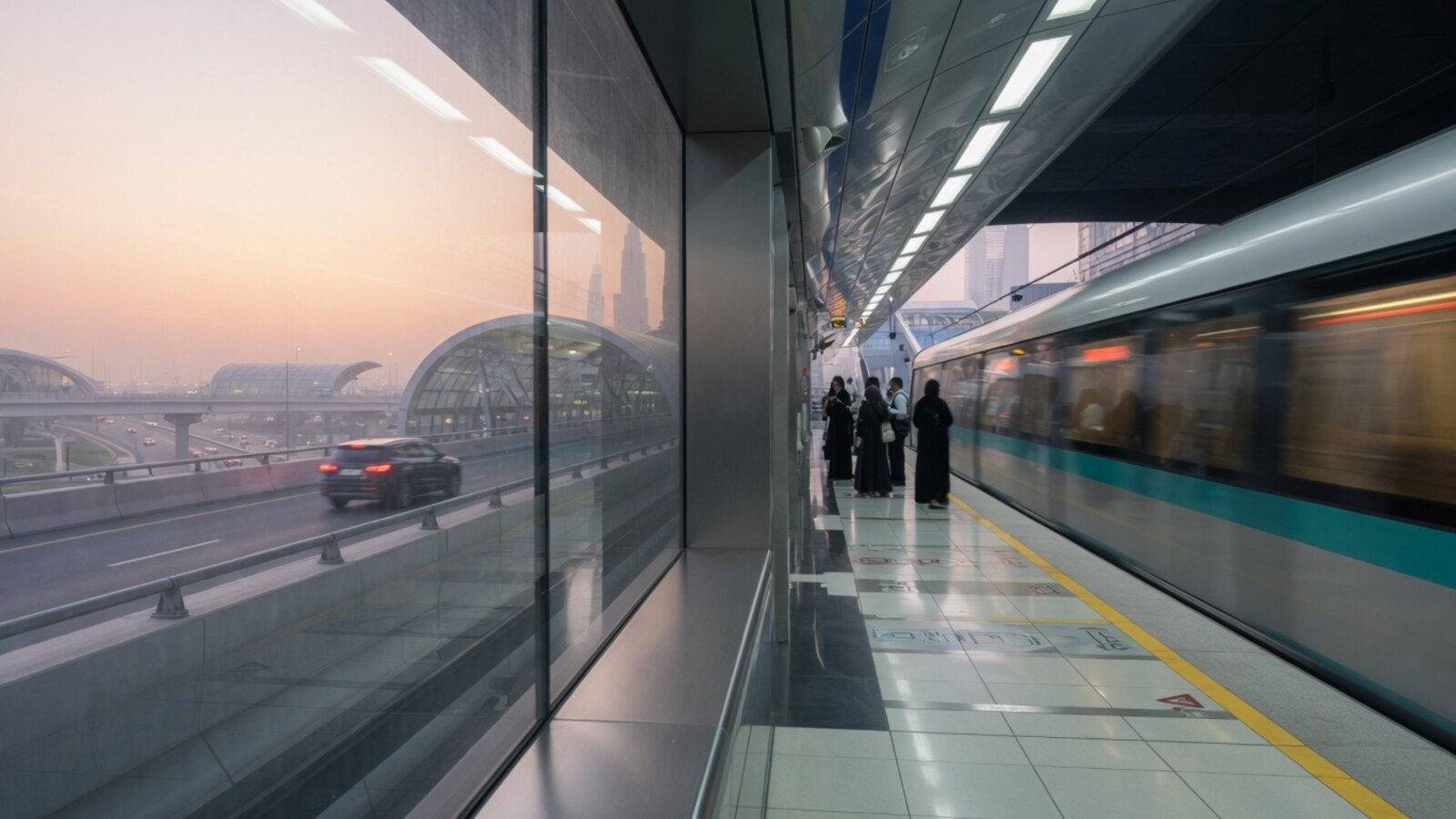
Dubai Driving vs Metro: Choosing Your Daily UAE Commute Strategy
Deciding between private car ownership and the RTA Metro network in Dubai depends on zone fares, daily routes, parking fees, and registration rules.
A new resident standing in Business Bay during evening rush hour faces an immediate decision between walking to the Metro station or driving through traffic. Choosing between private car ownership and public rail transit shapes your monthly budget, daily routine, and residential location in Dubai. Comparing driving and Metro options helps identify which commute strategy fits your working pattern.
Evaluating transit in Dubai requires understanding how municipal infrastructure connects residential communities with commercial districts. While the city features extensive highway networks, public transit under Dubai's Roads and Transport Authority (RTA) offers a structured alternative for daily travel.
Structural Trade-Offs of Daily Transit in Dubai
Dubai operates its public transit network through a unified tariff structure across seven travel zones. Every Metro, Tram, and public bus station sits within one of these defined zones. Your daily commute cost on public transport depends entirely on the number of zones you traverse during a single journey rather than a flat ticket price.
Private vehicle operation presents a different structural model based on fixed overheads and variable road charges. While car ownership provides door-to-door flexibility across all urban areas, it introduces ongoing commitments such as vehicle maintenance, insurance coverage, and parking management.
For expats managing initial setup in the emirate, separating vehicle ownership rules from driving permissions is essential. RTA registration procedures allow residents to hold title to a car before finalizing their driver licensing process, though driving the vehicle without a valid licence remains illegal on public roads.
Option A: Commuting via the RTA Metro Network
The Dubai Metro system forms the central spine of public transportation in the emirate. Daily commuters rely on the nol card system, an electronic ticketing platform managed by RTA that covers Metro trains, Dubai Tram, public buses, marine transport, RTA taxis, and RTA paid parking.
Both Silver and Gold nol cards cost AED 25 at purchase, which includes AED 19 of pre-loaded travel credit, and remain valid for 5 years. For regular daily commuting, the Silver card is the standard option across all RTA modes at standard fares. The Gold card permits access to the Gold Class carriage on Metro and Tram services, with per-trip fares running roughly double the Silver rate.
Fare calculations follow specific zone tiers. On a Silver card, traveling within a single zone costs AED 3, crossing two adjacent zones costs AED 5, and traveling across more than two zones costs AED 7.50. Paper Red Tickets cost AED 4 for one zone, AED 6 for two zones, and AED 8.50 for more than two zones. Gold Class fares are charged at AED 6 for one zone, AED 10 for two adjacent zones, and AED 15 for more than two zones, with the Gold surcharge applied once per zone even if changing trains within that same zone.
Before entering any Metro gate, your nol card must hold a minimum balance of AED 7.50. If the balance falls below AED 7.50, the turnstile will not open. If a card is lost, damaged, faulty, or expired, residents can submit a refund application via the RTA website, Smart Kiosks, or the nol Pay app. Refunds are approved within 4 working days, and residents can collect cash at Metro stations or transfer the balance to a registered card.
For a detailed breakdown of card registration and pass types, read our guide on public transport cards for Dubai newcomers.
Option B: Operating a Private Vehicle in Dubai
Driving a private car in Dubai provides complete independence from rail schedules and feeder bus routes. Vehicle owners can travel directly between suburban residential developments and commercial hubs without transferring between modes.
Under RTA guidelines, you can register a vehicle in your name in Dubai without holding a UAE driving licence. Registration requires presenting your Emirates ID, vehicle insurance, technical inspection approval where applicable, and proof of ownership such as a purchase agreement or customs certificate. However, operating the vehicle on public roads strictly requires holding a valid UAE driving licence.
Car ownership involves ongoing costs including fuel, maintenance, road tolls, and RTA paid parking fees. Conveniently, drivers can use their standard nol card to pay for RTA paid street parking and Pay & Display meters, as well as RTA taxi fares, using the balance stored on the card.
Choosing between driving and rail transit in Dubai is less about lifestyle prestige and more about mapping your daily start and end points against the RTA zone network.
Digital nol card integration via the nol Pay app allows phone-based wallet payments for RTA paid parking and public transport alike. This simplifies daily transactions for drivers and riders.
Cross-Emirate Transit and Hybrid Alternatives
Commuters working across emirate boundaries or traveling frequently between Dubai and Abu Dhabi can use specialized transit options alongside private driving.
RTA launched a shared taxi trial service between Ibn Battuta Mall in Dubai and Al Wahda Mall in Abu Dhabi in November 2024. In December 2025, RTA extended the trial by six months due to demand and introduced additional trial locations. These new locations connect Al Maktoum International Airport with Dubai Marina Mall, Business Bay Metro Station, and Palm Jumeirah Atlantis Monorail Station. They also link Dubai World Trade Centre with Business Bay Metro Station, Al Satwa Bus Station, and Dubai Marina Mall.
The full sedan shared taxi fare of AED 264 is split among passengers: AED 132 each for 2 riders, AED 88 each for 3 riders, or AED 66 each for 4 riders. A van option splits a similar total fare among up to 6 passengers. Passengers can pay using a bank card or nol card.
If you want to compare short-term vehicle access against on-demand hailing, consult our guide on car sharing versus taxi usage in your first months in the UAE.
Decision Matrix: Who Should Choose Which Option
Evaluating dubai driving vs metro trade-offs requires mapping your daily transit locations against RTA zone boundaries and parking infrastructure.
Choose the RTA Metro network if:
- Your home and office are within short walking distance of Red or Green Line Metro stations.
- You prefer fixed, predictable transport expenses based on official zone rates starting at AED 3 for Silver card trips.
- You want to avoid managing vehicle registration, annual technical inspections, insurance policies, and parking search.
Choose private driving if:
- Your residence is located in suburban or villa communities without direct Metro feeder bus access.
- Your daily routine requires multi-stop journeys, client visits, or family transport across non-rail commercial hubs.
- You regularly travel outside Dubai to other emirates where rail connections do not exist.
Choose a hybrid strategy if:
- You rely on the Metro for daily office commutes along Sheikh Zayed Road to avoid peak traffic, but use shared taxis or short-term rentals for weekend travel to Abu Dhabi.

Author
Expat Pocket Editorial
Editor