Living in JLT Dubai: Field Notes on Clusters, Metro, and Rules
An insider field report on living in JLT Dubai. Explore cluster layouts, metro access, building management rules, lease registration, and official expat requirements.
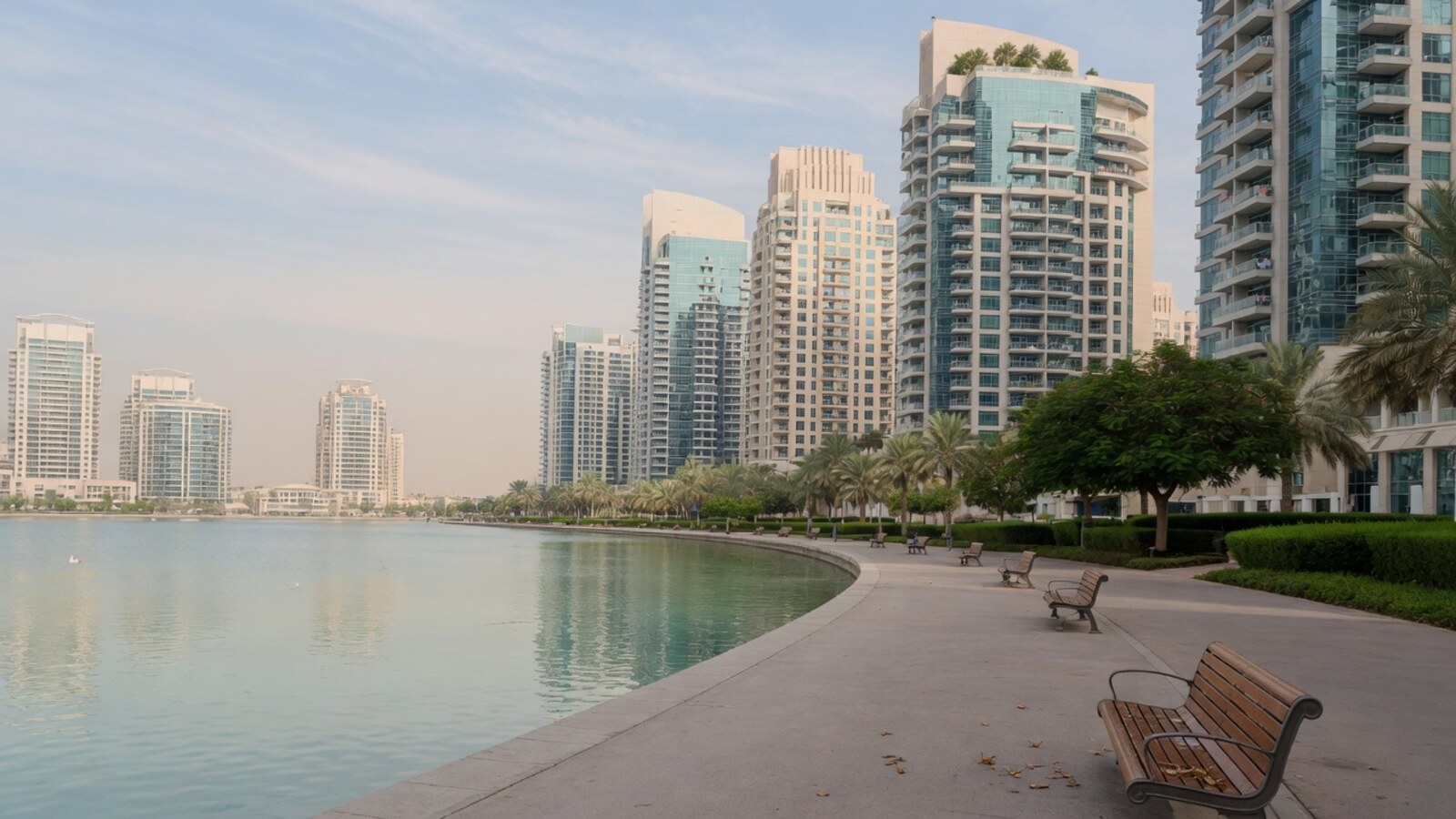
A morning breeze carries the sound of footsteps across the raised concourse of Cluster V as residents stream toward the pedestrian bridges. High-rise residential towers frame the artificial lake. Their glass facades catch the early sun as delivery couriers move along the lower ring road. For newcomers evaluating living in jlt dubai, watching this morning routine shows how the area functions. The neighborhood operates as a group of small, connected communities rather than one uniform development.
Pedestrian flow centers heavily around the podium levels where retail shops, cafes, and laundry services line the walkways. Each of the 26 clusters, labeled from A to Z, groups three towers around a shared base structure. Living on a podium level near the lake edge gives immediate access to walking paths. Living in an outer tower facing Sheikh Zayed Road requires using elevated crosswalks and traffic loops.
The Morning Concourse Walk at Cluster V
A walk along the waterfront path at Cluster V shows how location shapes daily life. Residents living in clusters close to the central park have open green space and playground access without crossing major roads. Residents in northern clusters like Cluster A or Cluster B trade park access for faster driving routes onto the main highway.
Commercial density varies across cluster basements and podium levels. Certain clusters host major supermarket chains and medical clinics on their ground floors. Others stay strictly residential with minimal retail foot traffic. Checking cluster amenities on foot before picking an apartment prevents unexpected trips for daily supplies.
Before finalizing a long-term lease, running a commute test before signing a lease helps confirm if walking to the station works in summer heat.
Waiting at the Crosswalk near DMCC Metro Station
Commuters gather at the pedestrian signal near DMCC Metro Station as trains arrive every few minutes on the elevated track. The proximity of DMCC Station and Sobha Realty Station makes JLT one of the most transit-accessible high-rise communities in Dubai. However, reaching the metro platform from clusters situated on the far side of the lakes takes ten to fifteen minutes on foot across podium bridges.
Standing on the Cluster V podium at eight in the morning teaches you more about daily life in JLT than any brochure.
Public transport reliance in JLT depends on your tower position relative to these two red line metro stations. RTA feeder buses loop around the outer perimeter road and link outer clusters to the stations, though peak traffic causes delays. Residents who commute daily to financial districts often pick towers in Clusters C, D, O, or P to shorten the walk to transit gates.
Understanding building rules keeps daily life peaceful. Read our guide on apartment tower neighbour etiquette to share amenities without issues.
Reviewing Tower Contracts at Cluster C Concourse
A tenant sits at an outdoor cafe in Cluster C and reads a lease agreement alongside lobby notices. Property management policies across JLT towers differ significantly because separate sub-developers oversee individual buildings. Some tower boards set strict rules on balcony use, pets, and move-in paperwork. Others follow wider guidelines.
Balcony rules in Dubai high-rises carry legal and financial penalties from developers and city authorities. Building managers post notices against cigarette ash, shisha, and barbecues because of fire risks. RERA guidelines treat shisha and barbecues on balconies as severe fire hazards with fines up to AED 2,000. Balcony misuse penalties from Dubai Municipality run between AED 500 and AED 1,500.
Financial planning for a move into JLT includes setting up a bank account early. UAE banks do not require a minimum residency period before an expat can apply for a personal loan, as long as the applicant meets standard underwriting rules. ADCB requires a fixed monthly salary of at least AED 5,000, a minimum age of 21, and salary transfer into an account with the bank.
If you are choosing between short-term stays and long-term leases, read about hotel apartment vs annual lease choices.
Opening the Dubai REST App on Move-In Day
Inside a newly handed-over apartment, a tenant logs into the Dubai REST app using UAE PASS credentials to set up household records. Dubai Land Department requires primary leaseholders to register co-occupants living in the unit, including family members or long-term partners. Entering Emirates ID numbers and birth dates for co-occupants is optional in the app. However, primary tenants must submit the total count of residents, and landlords face penalties if records are incorrect.
Unmarried partners relocating to Dubai often ask about local laws. Under Article 409 of Federal Decree-Law No. 31 of 2021, authorities cannot start legal proceedings for consensual sexual relations outside marriage unless a spouse or legal guardian files a formal complaint. In practice, two single adults living together face no prosecution, so unmarried cohabitation is allowed.
Regarding temporary visitors, Article 19 of Dubai Law No. 26 of 2007 states that short-term guest stays by partners or relatives do not require landlord consent. Only long-term residency requires co-occupant registration on Ejari.
Unpacking Household Shipping Crates and Preparing School Forms
A moving truck parks in the basement loading bay of Cluster T as movers unload customs documents and furniture boxes. Importing used personal items into Dubai for the first time is exempt from customs duty and 5 percent VAT. This exemption applies to foreigners moving to the UAE for their first residence period. Items must be used, brought in reasonable quantities, and listed on a detailed packing inventory with proof of prior living abroad.
Expat residents returning to Dubai after an earlier stay do not automatically get tax exemptions on a second move. Dubai Customs reviews returning cases individually, and disputed import files go to the Tariff and Origin Department.
Getting identity documents takes time after arrival. The ICP express 24-hour Emirates ID service applies only to UAE citizens and GCC nationals on first-time applications. Foreign residents getting their initial card must wait through standard processing, though fast-track replacement remains open for lost cards.
Families with school-age children in jlt dubai must meet local health rules before school starts. Dubai Health Authority applies the National Immunization Program to all resident children regardless of nationality. Private schools across Dubai ask for complete vaccination records during enrolment.
JLT does not have private school campuses inside its residential clusters, but nearby neighborhoods fill the gap. Al Barsha has Harrow School Dubai and Brighton College Dubai. Al Furjan contains Arbor School and Dubai British School Jumeirah Park. Expat schools in Dubai operate without fixed district boundaries, so living near a school is a matter of convenience rather than admission eligibility.

Author
Expat Pocket Editorial
Editor